
Child–robot relationship formation: A narrative review of empirical research
How do children form a close and trusting relationship with a robot? 🤝 🤖

Library › Papers on Children, Robots, and AI
Young Children and ChatGPT: Parents' Use of ChatGPT in Parenting
Child–robot relationship formation: A narrative review of empirical research
Shall I Trust You? From Child–Robot Interaction to Trusting Relationships
Investigation on Empathy Towards Humans and Robots using fMRI
Digital Inequality and Developmental Trajectories of Low-income, Immigrant, and Minority Children
A Social Robot Connected with ChatGPT to Improve Cognitive Functioning in ASD Subjects
Humans Create More Novelty Than ChatGPT When Asked to Retell a Story
Assessment of Engagement and Learning During Child-Robot Interaction using EEG Signals
Can Machines Think? Interaction and Perspective Taking with Robots Investigated via fMRI
Investigating Conversational Dynamics in Human-Robot Interaction with fMRI
Interesting paper I read today:
Authors:
Caroline van Straten, Jochen Peter & Rinaldo Kühne
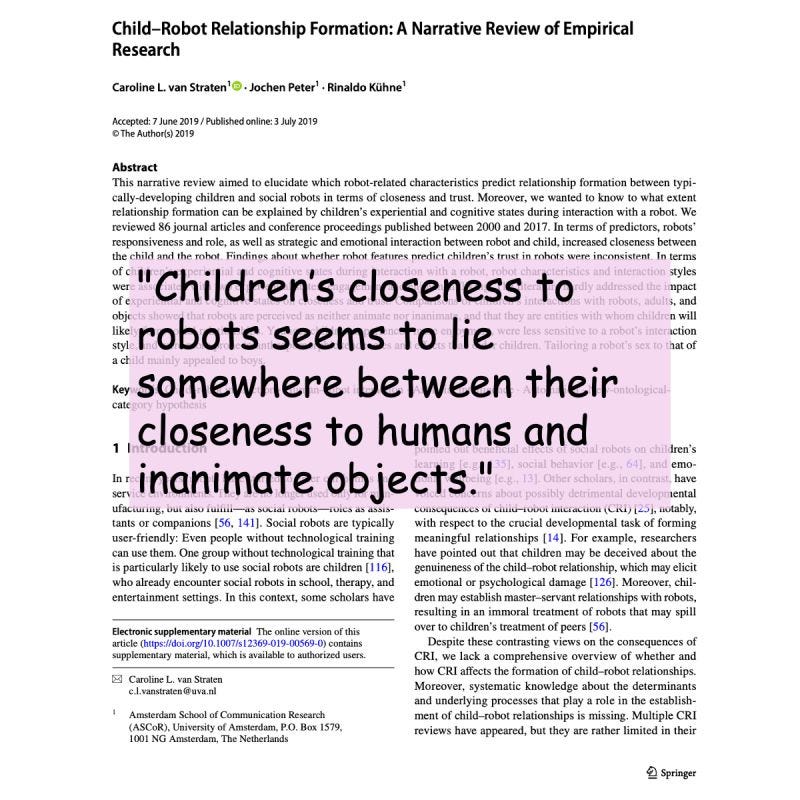
Here's a brief summary I wrote:
In this review paper, the authors provide a comprehensive overview of the existing literature on the factors associated with child-robot relationship formation.
The focus is on two key dimensions: closeness and trust in children’s relationships with social robots. Most of the studies reviewed involved children aged 6 to 12.
Regarding robot characteristics, the robot’s responsiveness plays an important role in fostering a sense of closeness.
However, no specific robot characteristic appears to strongly predict trust; for instance, embodiment was positively associated with closeness but not with trust.
Furthermore, robot responsiveness, tailoring, and embodiment were all linked to enjoyment and engagement—mental states that can lead to closeness and trust.
However, these factors did not significantly influence other mental states, such as empathy or anthropomorphism.
Interestingly, children reported feeling a sense of closeness to robots that fell somewhere between their feelings toward humans and inanimate objects, yet in some cases, they trusted robots more than humans.
Younger children were more likely to enjoy interactions with robots compared to older children. The paper highlights that advanced technology may not be necessary to evoke feelings of closeness in children, as even simple robot features, like a certain level of responsiveness, can foster such connections.
On the other hand, further research is needed to better understand the psychological mechanisms through which children develop varying degrees of closeness and trust with robots.
Next:
6. Shall I Trust You? From Child–Robot Interaction to Trusting Relationships