
Large Language Models Have Divergent Effects on Self-Perceptions of Mind and the Attributes Considered Uniquely Human
Can even brief exposure to ChatGPT alter our perception of what uniquely makes us human?

Library › Papers on Children, Robots, and AI
Young Children and ChatGPT: Parents' Use of ChatGPT in Parenting
Child–robot relationship formation: A narrative review of empirical research
Shall I Trust You? From Child–Robot Interaction to Trusting Relationships
Investigation on Empathy Towards Humans and Robots using fMRI
Digital Inequality and Developmental Trajectories of Low-income, Immigrant, and Minority Children
A Social Robot Connected with ChatGPT to Improve Cognitive Functioning in ASD Subjects
Humans Create More Novelty Than ChatGPT When Asked to Retell a Story
Large Language Models Have Divergent Effects on Self-Perceptions of Mind and the Attributes Considered Uniquely Human
Assessment of Engagement and Learning During Child-Robot Interaction using EEG Signals
Can Machines Think? Interaction and Perspective Taking with Robots Investigated via fMRI
Investigating Conversational Dynamics in Human-Robot Interaction with fMRI
Today, I read an interesting paper about ChatGPT and psychology:
Authors: Oliver L. Jacobs; Farid Pazhoohi; Alan Kingstone
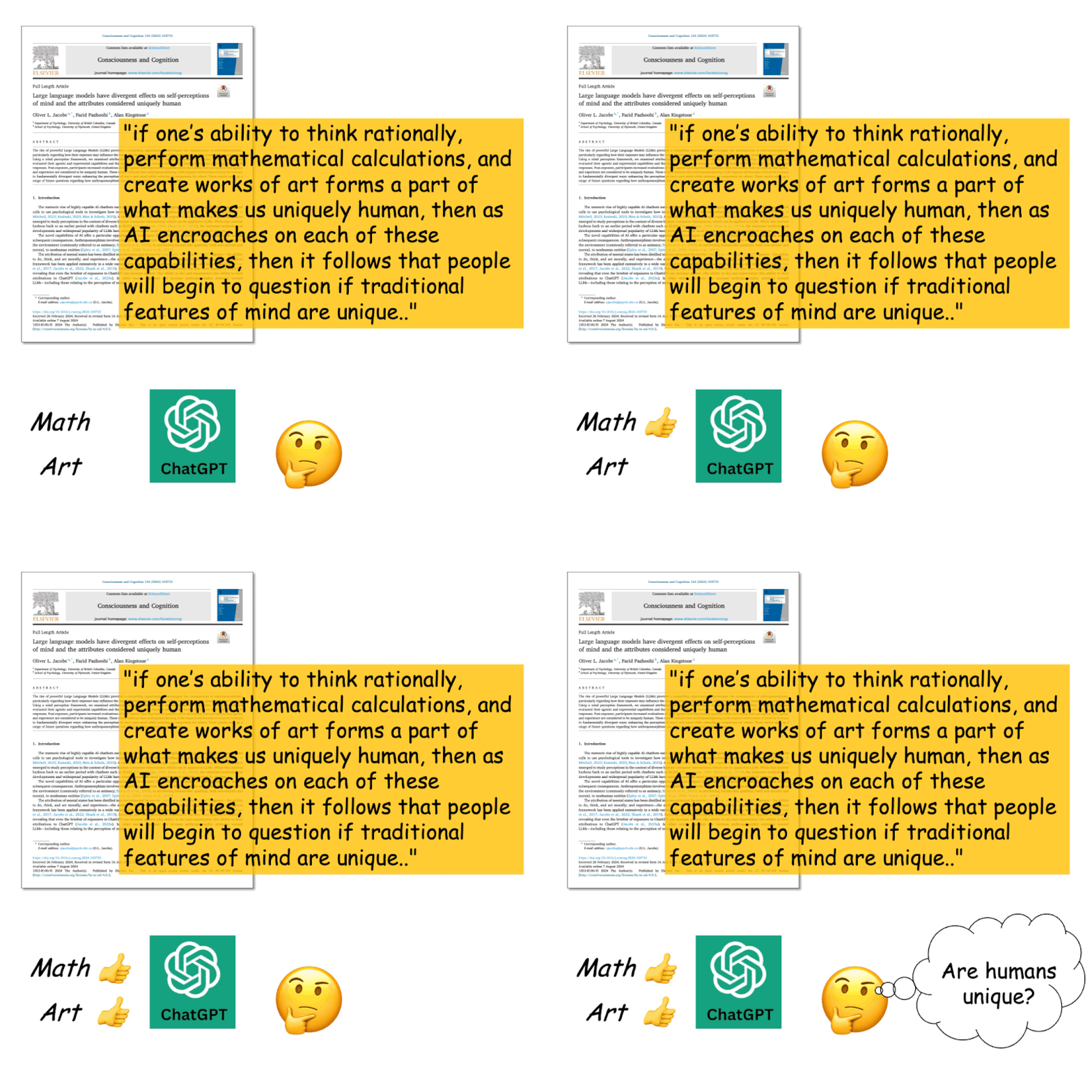
I wrote a summary to share with you:
As ChatGPT demonstrates intelligence, art creation, and even the ability to appear to understand emotions, many wonder what remains unique about humans.
This study explored whether brief exposure to ChatGPT influences perceptions of our own abilities and the uniqueness of being human.
The researchers conducted an online survey with 133 participants, averaging 40 years old, who completed questions about their mind's capacity to act (agency) and feel (experience) before and after reading scenarios showcasing ChatGPT's ability to answer difficult questions.
The results showed that participants rated their own mind’s ability to act and feel higher after being exposed to ChatGPT's capabilities.
However, they rated the uniqueness of the human mind lower after the exposure.
These findings suggest that we may have a protective mechanism that allows us to downplay ChatGPT's abilities when directly comparing them to our own.
However, when this comparison extends to all humans, participants exhibited signs of greater concern over what is truly unique about humanity.
The authors also noted that participants not only questioned the human mind’s unique ability to do but also its capacity to feel after being exposed to ChatGPT.
🤔 As a developmental psychologist, I am also concerned about this impact on children.
Given that ChatGPT can solve challenging problems effortlessly, children may feel threatened by its ability, and question why they need to invest any effort in learning.
As interactions and collaborations with intelligent AI increase, it will be crucial for people to accurately understand the extent of AI’s capabilities.
💡This understanding could help reduce threats that people experience about what makes humans unique and allow AI’s influence to have a more positive impact on creativity and productivity.