
Using Near Infrared Spectroscopy to Index Temporal Changes in Affect in Realistic Human-Robot Interactions
What does prefrontal cortex activation 🧠 ⚡ during interactions with a robot 🤖 indicate?

Library › Papers on Children, Robots, and AI
Young Children and ChatGPT: Parents' Use of ChatGPT in Parenting
Child–robot relationship formation: A narrative review of empirical research
Shall I Trust You? From Child–Robot Interaction to Trusting Relationships
Investigation on Empathy Towards Humans and Robots using fMRI
Using Near Infrared Spectroscopy to Index Temporal Changes in Affect in Realistic Human-Robot Interactions
Digital Inequality and Developmental Trajectories of Low-income, Immigrant, and Minority Children
A Social Robot Connected with ChatGPT to Improve Cognitive Functioning in ASD Subjects
Humans Create More Novelty Than ChatGPT When Asked to Retell a Story
Assessment of Engagement and Learning During Child-Robot Interaction using EEG Signals
Can Machines Think? Interaction and Perspective Taking with Robots Investigated via fMRI
Investigating Conversational Dynamics in Human-Robot Interaction with fMRI
Today, I read an interesting paper about brain and human robot interaction:
Authors:
Megan Strait
Matthias Scheutz
I wrote a summary:
Functional near-infrared spectroscopy (fNIRS) is a non-invasive brain imaging technique that uses near-infrared light to measure changes in blood oxygen levels in the brain, which reflect brain activation.
fNIRS has advantages over other brain imaging methods, such as greater portability compared to fMRI (allowing participants to wear a cap and move around) and better spatial resolution than EEG.
In this pioneering study, researchers used fNIRS to assess participants' emotional responses during real-time interactions with robots.
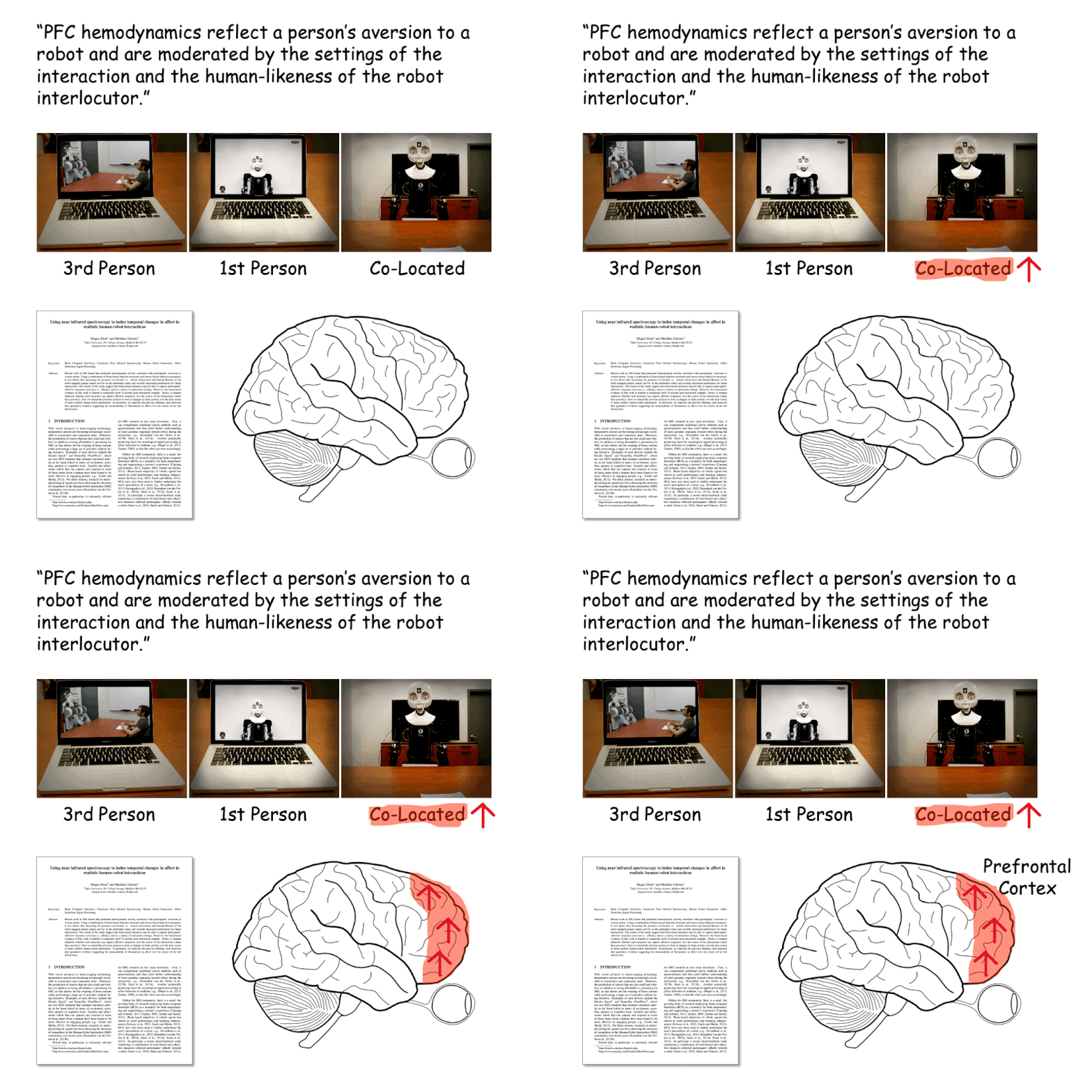
The study involved 38 young adult participants and included two types of robots: one stereotypical and one more human-like, across three conditions: observing the robot and another human remotely, remotely interacting with a robot, and directly interacting with a robot.
The fNIRS results during the first interaction suggested that brain activation, specifically in the prefrontal cortex (PFC), was highest when participants interacted directly with the more human-like robot.
Interestingly, contrary to some findings that suggest participants prefer human-like features in robots, PFC activation reflected stronger emotional responses, primarily eeriness and aversion, toward the human-like robot. The PFC activation may also indicate increased efforts in emotion regulation among participants.
However, during repeated interactions, this initial heightened brain activation toward the human-like robot was not observed.
💡 These findings suggest that repeated interactions with a robot may reduce participants' initial negative emotional responses and make them feel more comfortable during the interaction.
💡 This study provides early insights into how the PFC responds to different types of robots and how these responses can be interpreted alongside participants' self-reported emotional experiences.