

Library › Papers on Children, Robots, and AI
Young Children and ChatGPT: Parents' Use of ChatGPT in Parenting
Child–robot relationship formation: A narrative review of empirical research
Shall I Trust You? From Child–Robot Interaction to Trusting Relationships
Investigation on Empathy Towards Humans and Robots using fMRI
Digital Inequality and Developmental Trajectories of Low-income, Immigrant, and Minority Children
A Social Robot Connected with ChatGPT to Improve Cognitive Functioning in ASD Subjects
Humans Create More Novelty Than ChatGPT When Asked to Retell a Story
Assessment of Engagement and Learning During Child-Robot Interaction using EEG Signals
Can Machines Think? Interaction and Perspective Taking with Robots Investigated via fMRI
Investigating Conversational Dynamics in Human-Robot Interaction with fMRI
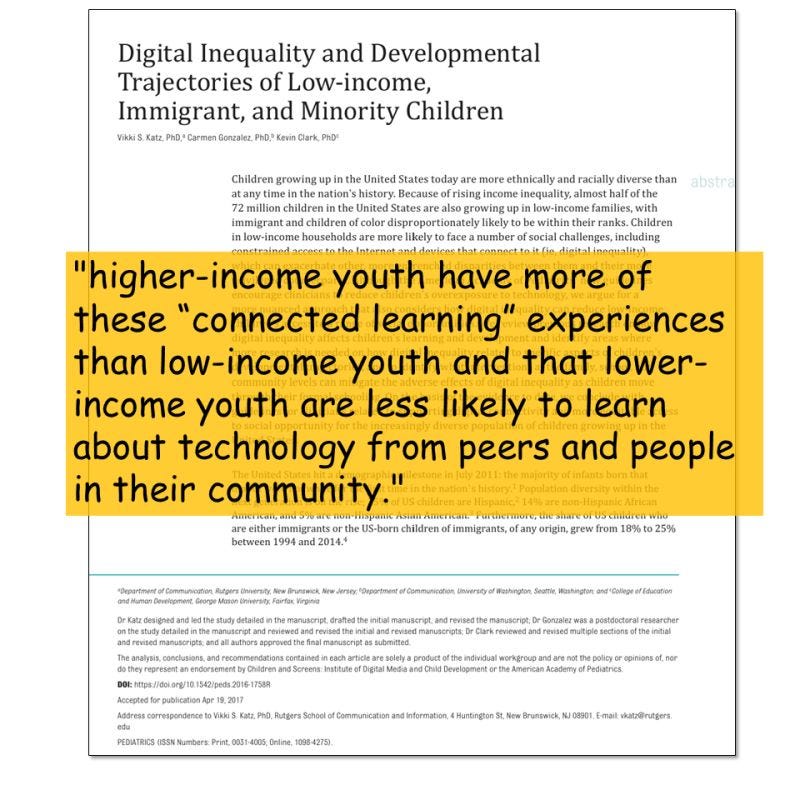
Today, I read an interesting paper about digital inequality and child development:
Authors: Vikki S. Katz; Carmen Gonzalez; Kevin Clark
I wrote a summary to share with you:
The American Academy of Pediatrics (AAP) recommends limited media use in children due to concerns about its negative impact on child development. There is also concern that excessive media use may reduce time spent on activities more beneficial to child development, such as play and exercise.
However, an additional issue related to this recommendation is digital inequality, which refers to disparities in access to technology, such as the internet and digital devices, as well as opportunities to learn digital skills like STEM education and coding.
The authors of this paper argue, based on their survey of over 1,000 parents of school-aged children from low-income households, that there is significant digital inequality by income level.
In low-income households, it is not that parents and children have no access to the internet, but that they lack reliable and sufficient access. Many people in these households share one device, or their access may be limited to mobile devices, which restricts their ability to fully utilize educational resources, connect with teachers, or explore job opportunities.
This limited access also hinders children’s opportunities for connected learning and the development of digital skills.
This is also connected with another important issue I learned from a recent webinar I organized on the topic of technology and child development.
Dr. Patti Ordoñez argued that one significant barrier for children from minority backgrounds in pursuing technology-related careers is that they are less likely to have parents working in the tech field, making it harder for them to envision themselves in that industry. To address this, she is currently conducting innovative work to teach coding to parents and grandparents in these communities.
I agree with the authors that it is critical to support digital access and opportunities for learning digital skills in low-income communities to reduce achievement and opportunity gaps.
I believe it is important to examine the type of media children are exposed to based on income levels. Research shows that more interactive technology is better for children’s learning, but it often requires faster internet and more functional devices—resources that low-income families may lack, leading them to rely more on passive technologies such as YouTube videos.
With the rapid development and use of generative AI, addressing digital inequality is even more urgent to ensure that children are prepared for a workforce that will likely require various AI-related skills.
Next:
15. Family Learning Talk in AI Literacy Learning Activities