

Library › Papers on Children, Robots, and AI
Young Children and ChatGPT: Parents' Use of ChatGPT in Parenting
Culturally Variable Preferences for Robot Design and Use in South Korea, Turkey, and the United States
Child–robot relationship formation: A narrative review of empirical research
Shall I Trust You? From Child–Robot Interaction to Trusting Relationships
Investigation on Empathy Towards Humans and Robots using fMRI
Digital Inequality and Developmental Trajectories of Low-income, Immigrant, and Minority Children
A Social Robot Connected with ChatGPT to Improve Cognitive Functioning in ASD Subjects
Humans Create More Novelty Than ChatGPT When Asked to Retell a Story
Assessment of Engagement and Learning During Child-Robot Interaction using EEG Signals
Can Machines Think? Interaction and Perspective Taking with Robots Investigated via fMRI
Investigating Conversational Dynamics in Human-Robot Interaction with fMRI
Interesting paper I read today:
Culturally Variable Preferences for Robot Design and Use in South Korea, Turkey, and the United States
Authors:
Hee Rin Lee
Selma Šabanović
Below is a brief summary I wrote:
Culture is associated with different social norms, beliefs, and expectations, which can influence people’s expectations and preferences regarding a robot’s role in their everyday lives.
In this online survey study, the researchers recruited adult participants from three countries: Korea, the United States, and Turkey.
The most distinctive cultural differences emerged in participants' preferences for the robot’s role in their lives.
Korean and Turkish participants want robots to be present in various everyday settings, such as the home, school, and workplace, more so than participants from the United States.
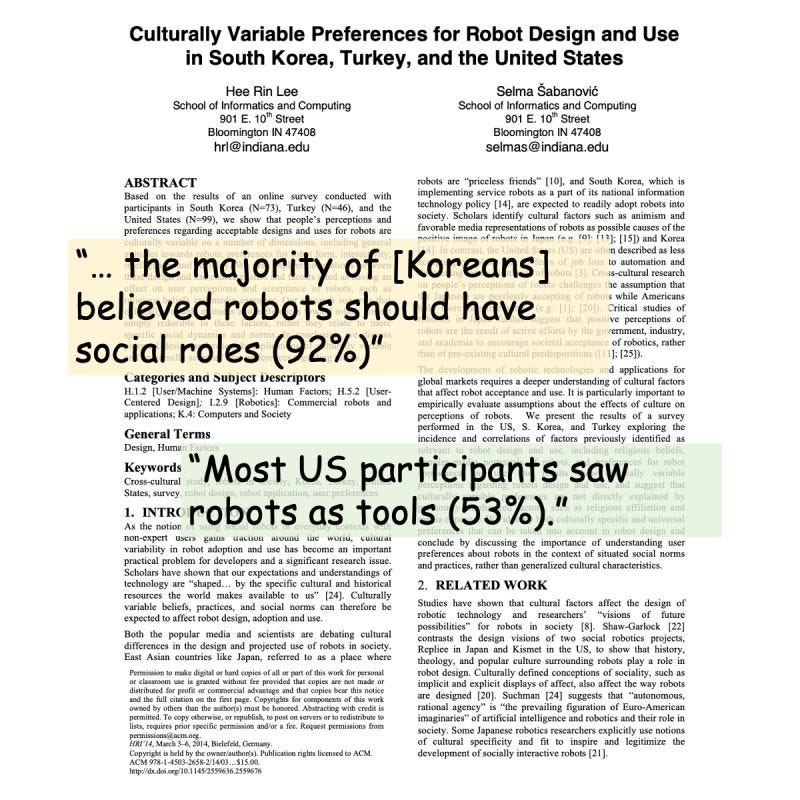
Korean participants, in particular, preferred that robots have social roles, though they predominantly saw these roles as supportive, such as assistants.
In contrast, U.S. participants preferred that robots not assume social roles but rather function as tools to be used. Interestingly, religious affiliation did not significantly influence preferences regarding robot characteristics across the three countries.
However, culturally based beliefs had a strong impact. For example, in Korea, the statement reflecting Confucian values—“A robot should know how to bow and whom to bow to”—was strongly associated with the acceptance of robots at home, a preference for human-like appearance, and a preference for female robots.
These findings suggest that while Koreans are open to robots playing social roles in their everyday lives, they expect these robots to embody cultural values such as social hierarchy and to play a subservient role in assisting with daily tasks.
The findings highlight the importance of understanding social norms within cultural contexts when designing robots intended to assist with various aspects of people’s lives.
Next:
5. Child–robot relationship formation: A narrative review of empirical research